Guide
The Leitner system: spaced repetition on paper
The box method that started it all. How the Leitner system works, why it's still a great way to learn the concept, and where it runs out of road.
Part of the Spaced repetition: the complete guide guide.
Before there were apps, there were boxes. The Leitner system is the analog ancestor of every spaced-repetition tool, and it is still one of the clearest ways to understand what spacing actually does. You can run it with index cards and a shoebox.
This guide explains how it works and, just as usefully, where it stops being enough.
How the box method works
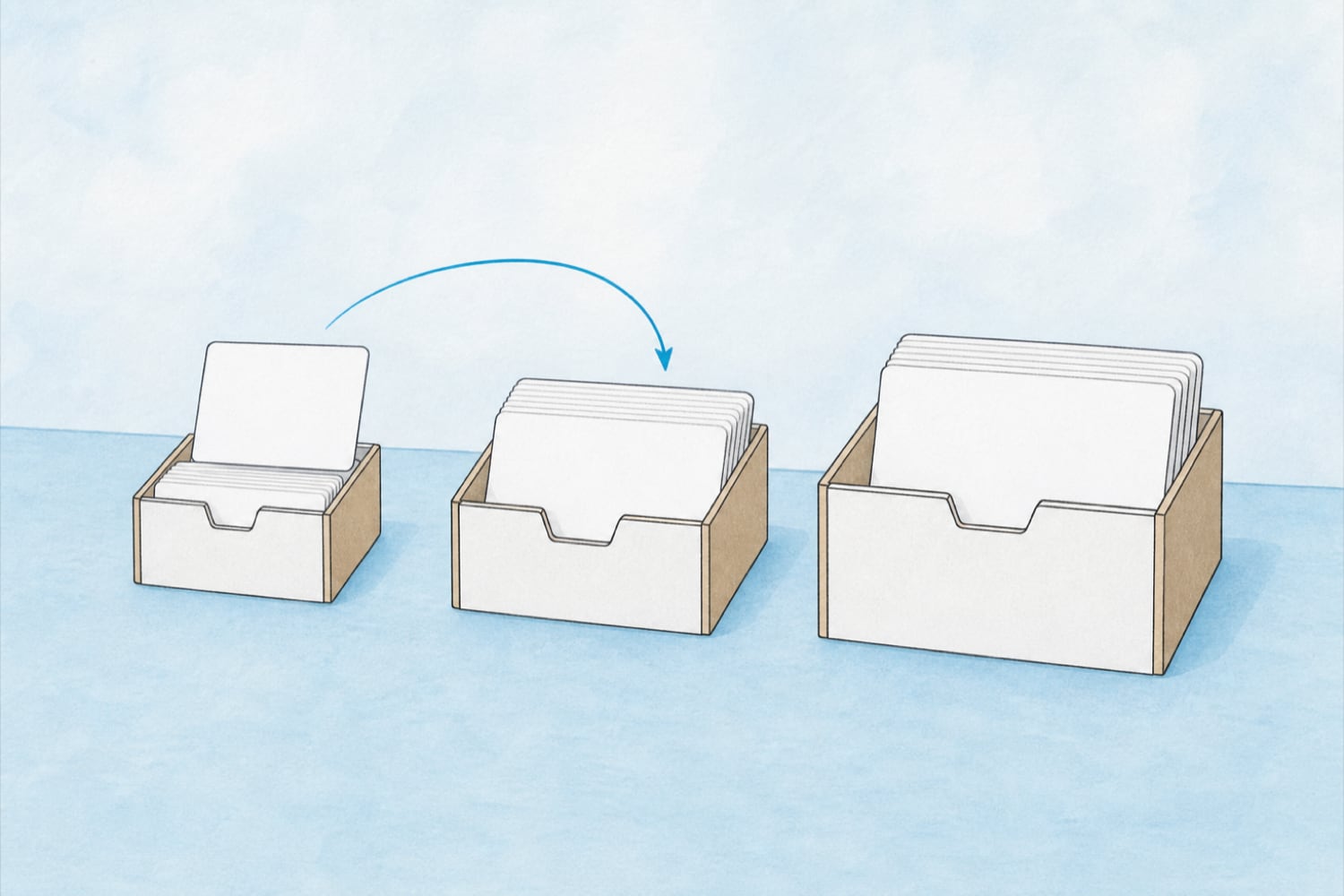
Sebastian Leitner popularized the system in the 1970s. The Leitner system uses a row of numbered boxes, each reviewed on a different schedule. Box 1 is reviewed often, box 2 less often, box 3 less often still.
The rule is simple:
- Every card starts in box 1.
- When you review a card and get it right, it moves up one box (so you will see it less often).
- When you get it wrong, it goes back to box 1 (so you will see it more often).
That is the whole system. Cards you know well drift toward the rarely-reviewed boxes; cards you keep missing stay in the frequent ones. Your attention automatically concentrates on the material you have not learned yet.
Why it works
The box method is spaced repetition made physical. A card climbing to a higher box is exactly the expanding interval you want: each correct recall earns a longer gap before the next review. The wrong-answer reset is the system catching a memory before it falls off the forgetting curve.
It also forces active recall by design. You cannot move a card up without actually trying to answer it. There is no passive rereading mode. That combination, retrieval plus expanding intervals, is the core of why spacing works at all, which is why a shoebox can genuinely teach you a few hundred vocabulary words.
Where it runs out of road
The Leitner system is a great teacher and a limited tool. Its weaknesses are exactly the ones software was built to fix:
- Fixed intervals per box. Every card in box 3 is treated identically, even though some are nearly mastered and some are borderline. The system cannot tune the schedule to the individual card.
- No memory model. It does not know your probability of recalling a given card; it only knows which box the card is in. Algorithms like SM-2 and especially FSRS improve on this by adjusting each card’s interval from your actual performance.
- Manual bookkeeping. With a few dozen cards it is pleasant. With a few hundred across several subjects, tracking which box is due when becomes its own chore, which is the same scheduling problem that defeats most paper systems.
When to use it anyway
None of that makes the box method useless. For a small, contained set of facts (a vocabulary list, a glossary, the bones of the hand) it is tactile, distraction-free, and genuinely effective. Plenty of people learn faster with cards they can hold.
The moment your material grows past one tidy box, or spreads across subjects, the bookkeeping is the thing that breaks, not the method. That is where a tool that keeps the schedule for you earns its place. Memset is one such tool: it applies the same expanding-interval idea the Leitner system pioneered, across everything you are studying, without the boxes to shuffle. The principle is Leitner’s; the part it removes is the manual sorting.