Guide
Interleaving vs blocked practice
Studying one topic at a time feels efficient and isn't. Here is what interleaving is, why mixing topics improves retention, and how it pairs with spaced repetition.
Part of the Spaced repetition: the complete guide guide.
Most people study in blocks: all of topic A, then all of topic B, then all of topic C. It feels organized and it feels productive. The research says a different approach, mixing topics together, usually works better, even though it feels worse while you do it.
That approach is called interleaving, and it pairs naturally with spaced repetition.
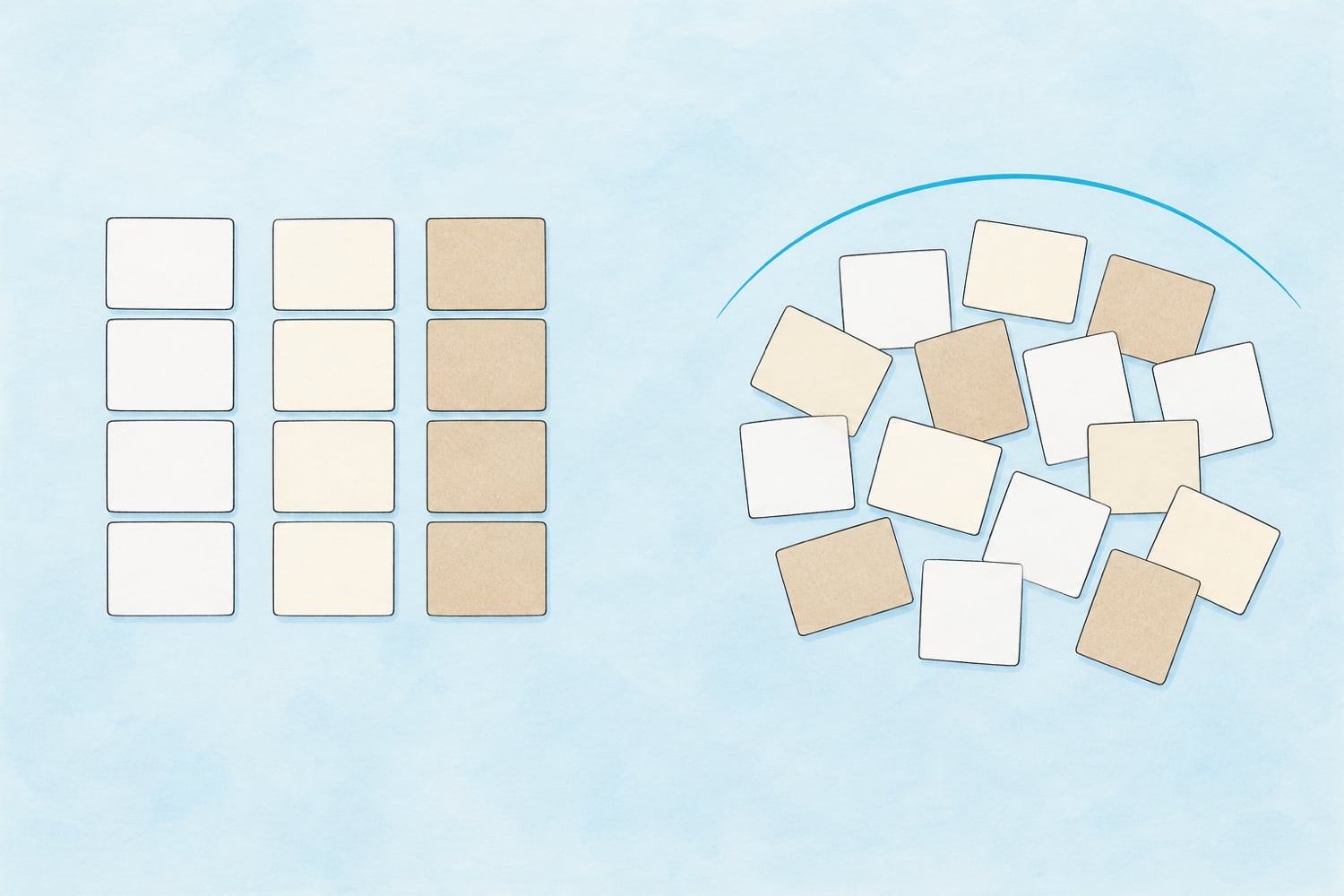
Blocked vs interleaved
Blocked practice is studying one kind of thing until you move on: twenty French verbs, then twenty nouns, then twenty adjectives. Interleaving mixes them: a verb, then a noun, then an adjective, then back to a verb, in varied order.
Blocking feels smoother because once you are “in” a topic, each item is easy. Interleaving feels harder because you keep switching contexts and cannot coast. That difficulty is the point.
Why mixing wins
When topics are interleaved, your brain has to do an extra piece of work on every item: first figure out which kind of problem this is, then solve it. Blocked practice removes that step (you already know every item is a French verb), so you never practise the discrimination you will actually need later, when problems do not come pre-sorted.
Studies on this, notably work by Rohrer and Taylor on math practice, found that students who interleaved problem types did worse during practice but substantially better on a later test than students who blocked. The mixing forces retrieval and forces you to tell similar things apart, both of which build more durable, more flexible knowledge.
This is one of psychologist Robert Bjork’s “desirable difficulties”: conditions that slow you down during study but improve long-term retention. The smoothness of blocked practice is a kind of illusion, the same family as the illusion of fluency that makes rereading feel productive.
Where it helps most
Interleaving is most valuable when you have to distinguish between similar categories:
- Math or physics problem types that look alike but need different methods.
- Vocabulary or grammar forms in a language that are easy to confuse.
- Anything where the real test is recognizing which rule applies, not just applying a rule you have already been handed.
For pure, unambiguous facts (a single vocabulary list with no confusable neighbours) the benefit is smaller, though mixing still adds useful retrieval practice.
How it fits with spaced repetition
Interleaving and spaced repetition are different ideas that reinforce each other. Spacing is about when you review (at growing intervals, riding the forgetting curve). Interleaving is about what order you review in within a session (mixed, not blocked). Both are forms of desirable difficulty, and both lean on active recall.
In practice they combine easily. A spaced review session that pulls due items from several topics at once is already interleaved by nature, which is one quiet advantage of reviewing across your whole body of material instead of one subject at a time. A schedule that surfaces “today’s due reviews” from everything you are studying mixes topics for you, no extra effort required.
That cross-subject review is exactly how Memset works: it does not drill one deck at a time, it tells you what is due today across everything, which interleaves your practice as a side effect. See the complete guide for how the pieces fit together.